

Frequently Asked Questions
Wanlin Fire Equipment · Practical Product and Application Information
Best Hong Kong Wireless Manual Call Point and Sounder Fire Alarm Equipment Manufacturer | On Pong Ro
China Hong Kong IoT fire alarm equipment manufacturer and export supplier for wireless composite smoke and carbon monoxide alarm devices, LoRa fire alarm gateways with dual SIM, wireless manual call points, wireless sounders and beacons, IoT fire alarm control panels, monitoring platform device management packages and fire alarm transmission devices. Wanlin Fire supplies Hong Kong IoT fire alarm equipment packages, six storey target building equipment sets, subdivided unit device sets, corridor
Products and Services
Review relevant products, system options, application guidance, project support, and pre-sales or after-sales services.
Information for Selection
Compare the application scenario, functional requirements, installation environment, interfaces, communication method, quantity, and project schedule.
How Information Is Verified
Confirm model numbers, technical parameters, certifications, delivery terms, and compatibility against current product documents and agreed project requirements.
Executive Summary: Sourcing Hong Kong Wireless Manual Call Point and Sounder Fire Alarm Equipment from China for Occupied Buildings on On Pong Road
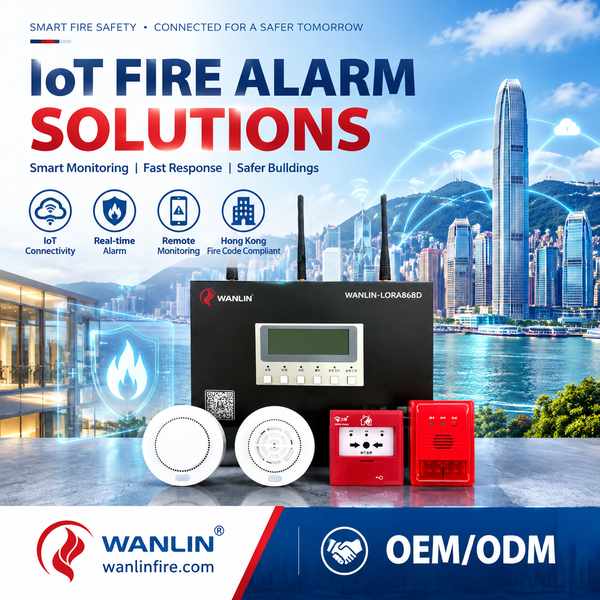
Blocks on this street were built before anyone writing the current rules was qualified. A walk of the staircase usually settles the gateway count faster than any calculation from the floor area. A programme on On Pong Road, in New Territories, needs equipment that can be carried up a staircase in a bag, fitted while the building stays occupied, and evidenced with documents somebody else signs. The scale behind that requirement is why overseas buyers are looking at Chinese factories now: the department puts the target building population at around 14,000, most of them completed or first submitted on or before 1 March 1987, and threading a hose reel through a staircase that was never drawn for one is not a realistic programme for most of that stock. This page is written for overseas distributors, regional contractors and sourcing teams who search for a factory rather than for a local installer, and it is written from job records rather than from a brochure.
TL;DR: an Internet of Things fire detection system together with portable fire extinguishers is accepted in place of a hose reel system and a manual fire alarm system, for a qualifying target building of six storeys or below, under the arrangement the department published on 30 April 2026. No other requirement under Cap. 572 moves. Three tests decide whether a building can use it: the ordinance covers it, a Fire Safety Direction has already been issued against it, and the owners have agreed to detectors in the common parts and in every unit. A quotation claiming a wider substitution than those two items should be asked for that claim in writing.
Case Study: On Pong Road Technical Services Manager Equipment Record
Nobody called us until the second letter arrived. The people involved were Vivian Chui, Technical Services Manager on the address, the appointed registered fire service installation contractor, and a monitoring provider who was named before the equipment was ordered. The building is on On Pong Road, in New Territories, and it had already been through one design that could not be built.
What the survey found was not what the drawings promised. The riser stopped two floors short of the top landing, the basement had no path up through the slab, and in one subdivided letting the only clear ceiling sat over a cupboard partition, which is not a position a head will do its job from. Two households refused entry on the first appointment round and were rebooked through the owners' corporation instead of being chased by the installers, which cost a week and saved a complaint. Before any equipment was priced, the question was how long the survey and the feasibility write up take, and that came to 19 days on site plus the report. The number that decided the design was the gateway count, and it came from walking the staircase with a meter rather than from dividing the floor area by a radius.
Key result: the common parts were completed and commissioned as one defined phase, the dwellings followed as appointments were granted, and the outstanding list stayed open as a written document instead of becoming a rumour. The one item still open at handover was a meter cupboard with no lawful position for a head, and it stayed on the list with a date against it rather than being quietly dropped. The saving against the rejected quotation was about 31 per cent, and it came from correcting the gateway count rather than from cheaper devices. Those figures are one building on one street, not a benchmark, and we will not present them as one.
Field case: One block on On Pong Road shared a staircase with the building next door and one gateway served the level. The point worth keeping is not that the equipment worked; it is that the failure had a name, a location and a date on it, which is what let it be closed in one visit rather than three arguments.
Problem Analysis & Field Report: Why Blocks on On Pong Road Need Hong Kong Wireless Manual Call Point and Sounder Fire Alarm Equipment
What follows is the list we hand a buyer before quoting, because it is cheaper than handing it over after an argument. On On Pong Road the old manual alarm stopped working after the last fit out and nobody reported it, which is how these files open. What follows is drawn from retrofit and compliance work in Hong Kong rather than invented for this page, and it is the list we would hand to a buyer before quoting rather than after an argument.
The same thing happened on the next street, and on the one after it. The device is rarely the reason a programme fails. It fails because a drawing was treated as a survey, because access was assumed, or because two parties each believed the other owned the transmission path. In quotations the three gaps that end up costing the most are predictable: a gateway count that never appears on the page, a battery figure quoted without the duty cycle or the temperature it was measured at, and radio evidence issued for a region the equipment will not be installed in.
- The manual trigger stays; automatic detection is added beside it rather than replacing it.
- Sound level is measured and recorded at commissioning, with doors closed.
- Siting follows the approved drawings and belongs to the appointed contractor.
- Bilingual instructions beside the call point are part of the equipment, not an afterthought.
What settled it was a comparison written down rather than a presentation. Written gateway counts from a survey. Per model datasheets with the conditions next to each figure. Radio compliance evidence for the operating region. A technical file written for the appointed contractor that states which parts of a scheme each document covers. The honest answer on timing here is 19 days from survey to a signed scope, with most of it spent on the owners corporation rather than on the building. A supplier who cannot answer those four in writing will not be there when the inspection asks the same questions.
What the Fire Services Department Means by an IoT Fire Detection System
Fire Services Department Circular Letter No. 3 of 2026 was published on 30 April 2026, after a pilot scheme in which ten buildings across Hong Kong Island, Kowloon and the New Territories were installed in the fourth quarter of 2025 and assessed from 1 January to 31 March 2026. The published results were zero fire false alarms, full system online availability and better than 99.95 per cent of components operating effectively. Those are the department figures from its own briefing, not our measurements, and they describe a supervised pilot rather than a guarantee for every installation.
The clause everybody misreads is the scope. Two requirements are substituted and only two: the hose reel system and the manual fire alarm system. Sprinkler requirements, emergency lighting, automatic interruption devices for mechanical ventilation and every other applicable measure stay exactly as they were. A supplier who says otherwise should be asked to put it in writing.
| Component | What it does | Who runs it |
|---|---|---|
| Wireless composite detector | Acts as a smoke detector and a carbon monoxide cell in one housing, with a pre alarm and a fire alarm stage to reduce false alarms | Installed and maintained by the appointed registered contractor |
| Gateway | Carries the manual call point and the sounder, holds the radio layer beneath it and the mobile backhaul above it, with two SIM cards on separate operators | Same contractor, with the mobile service under the transmission arrangement |
| Monitoring platform | Receives and processes signals, monitors device state, forwards fire signals onward through an approved transmission link | Monitoring service provider appointed for the building |
| Mobile application | Gives attending crews the device picture at the scene and the authorised control functions | Provided under the platform arrangement |
The four qualifying conditions all have to hold at once. The building falls under the Fire Safety (Buildings) Ordinance, Cap. 572. A Fire Safety Direction has been issued for it. It is a composite building or a domestic building of six storeys or below. Owners' consent covers detectors in the common parts and in every unit, transmission and alarm equipment in the common parts, and extinguishers on each floor. A building that fails any one of the four cannot use the route, whatever the hardware can do. Owners who want the department's answer rather than a supplier's can call the Building Improvement Support Centre on 2272 9112; we hand that number out because it settles arguments faster than we can and costs us nothing.
From Device to Communications Centre: Four Links That Must Not Be Separated
The chain is short and every link in it belongs to somebody different. A composite head detects and reports over radio to the floor gateway. The gateway carries the manual call point and the sounder, holds two SIM cards on separate mobile networks, and pushes the message out over mobile backhaul. The monitoring platform receives and processes it. From the platform, fire signals go to the Fire Services Communications Centre over an approved transmission link, the computerised link the department calls CFATS, and every signal is also duplicated to the department server over an application programming interface.
What overseas buyers get wrong is the contract boundary. Equipment supply, the platform service and the transmission service can be three separate agreements with three separate invoices and three separate people to call at two in the morning. We are the factory. We supply the equipment, the integration and the documented interface, and we say plainly that we do not hold a licensed monitoring service in Hong Kong. Any supplier who bundles all three without naming the licence is selling something they cannot deliver.
Two stage logic sits inside the first link and it is the reason the equipment survives contact with real residents. A single channel response produces a pre alarm and an investigation, which is a knock on the door. A confirmed fire indication goes straight through. The alternative is a device in a drawer within a month, which is the failure mode nobody records and everybody recognises.
The reason the route exists at all is the shift from a manual start to an automatic one. A manual system needs somebody to walk to a call point, decide, and press. A composite head starts the sequence with nobody present, at three in the morning if that is when it happens, and that is the argument for accepting detection in place of a manual alarm. It also moves the weight of the design onto cell life and false alarm behaviour, two things a wired scheme never had to care about.
Signal Timing, Heartbeat and What the Platform Has to Prove
The published timings are short, and they are worth reading before comparing two quotations because they are the numbers a commissioning sheet has to answer for.
- FIRE: within 10 seconds from mains powered equipment, within 20 seconds from battery powered equipment.
- PRE-ALARM: within 10 seconds from mains powered equipment, within 20 seconds from battery powered equipment.
- FAULT: within 20 seconds, whichever supply the position uses.
- STATUS: within 100 seconds, whichever supply the position uses.
- Heartbeat: polled at 30 minutes on mains powered equipment, at 24 hours on battery powered equipment.
Which positions are mains powered and which run on cells is a design decision recorded in the drawings, and it is what the ten or twenty second figure applies to. That is why the drawings matter more than the datasheet here. Redundancy follows the same logic: two SIM cards from separate operators for failover, dual power architecture at the gateway with cells carrying the field devices, and a supervised fault channel so a lost link shows as a fault rather than as silence.
The maintenance side has teeth. The registered contractor installs, maintains, inspects and repairs the fire service installation components and issues the certificate, and a repair not completed within thirty days is referred to the department. The main contractor is a single point of contact and carries a monthly performance report. Anybody quoting this equipment without naming who reads that report is quoting a system nobody is watching.
Where Devices Go, and Why the Radio Survey Comes Before Any Quotation
Placement is where the scheme is won. Inside a domestic unit the published position is the living room, near the main entrance; inside a non-domestic unit it follows the actual layout and the fuel load rather than a grid drawn for something else. At least one head goes into the common parts on every floor, and more where the floor area or the layout asks for them. At least two 5 kg dry powder portable extinguishers sit on every floor, recorded against a position rather than against a purchase order. That whole set is the published requirement, written by the authority, and none of it is a figure from our datasheet.
The cells in a wireless head are specified for more than three years of service, and that is a datasheet value measured under a stated duty cycle and temperature rather than a promise about a particular building. A head that dies in month thirty is a fault signal, an attendance and a conversation with the owners about who funds the visit, which is why we quote the figure with its conditions attached instead of as a headline.
The awkward part is rarely the count. It is the positions that do not exist. In a subdivided letting the only ceiling available may sit over a cupboard, and the only clear wall may leave the head in dead air beside a grille; neither position will do the job it was fitted for. Corridors carrying cooking need heat detection over the cooking point with composite heads elsewhere, chosen with the extraction running rather than on a quiet morning.
Rooftop plant enclosures, refuse rooms, switch rooms and meter cupboards are walked the same way, because a survey either covers the building or it does not. Where a block carries heritage status or appears on a graded list, expect separate approvals that have nothing to do with the equipment itself. The method that works is unglamorous. Tenants stay put through it, many of them elderly residents, and the detection programme usually runs alongside whatever renovation the block already has planned. Take what drawings exist, walk the building, place a gateway, measure, move it until the path is real, and record what was done.
Old building fabric does predictable things to a radio signal. A reinforced slab between floors does one thing, and a wet salt laden party wall shared with the building next door does something similar in pre war stock. Above a false ceiling shared by several lettings, the path is decided by what the grid itself is doing. Below ground, a basement level often has no path up at all, so the answer is a gateway on the level rather than an antenna fight with the slab.
Antenna extension fixes one position with a known problem; it does not rescue a gateway sitting in the wrong place, and we price it per unit because that is how tenders ask for it. One gateway per floor level plus one below ground is the usual starting point, and the number goes in writing before anything is priced. We do not reduce it to win a comparison, because the difference surfaces on site and by then it is the owner who pays for it.
Interference is measured during the walk rather than argued about after the first complaint, which is cheaper for everyone involved. Operating parameters are set for the region and recorded at commissioning, so the fifth building in a programme behaves like the first.
Commissioning is where the paperwork is either born or invented. Every device is recorded against floor, unit and gateway, the radio margin at each position is written down rather than assumed, and the fault channel is proved by taking one gateway offline and watching the platform report a fault instead of going quiet. A commissioning pack missing those three is a delivery note with a binder around it, and it will not survive an attendance.
Product Introduction: Hong Kong Wireless Manual Call Point and Sounder Fire Alarm Equipment by Wanlin Fire
What follows is the equipment set as ordered, with every figure either a system fact or a statement of where the figure comes from. The WANLIN-222 sounder is measured with the flat doors closed, not assumed from a floor plan. The WANLIN-222 sits at the centre of this configuration, and it is specified from the building rather than from the brochure. Whether wireless detectors are interconnected across units is a decision the appointed contractor records in the drawings, not something a supplier decides on site.
Technical Specifications
| Parameter | Specification |
|---|---|
| System reference | WANLIN-222 Hong Kong Wireless Manual Call Point and Sounder Fire Alarm Equipment |
| Product category | The manual half of the arrangement, which the circular does not remove: a person still has to be able to raise the alarm |
| Radio network | Call point on the radio layer to the floor gateway, which carries the sounder and the beacon for the level |
| Detection and trigger | Manual trigger plus the automatic heads beneath it, with both reaching the platform as separate event types |
| Supervision and health check | Call point and sounder report their own state, so a broken or painted over unit shows as a fault rather than as silence |
| Protocol and integration | Interface to the platform with fire, pre alarm, fault and status classes and the duplicate feed onward |
| Notification path | Sounder and beacon raise locally on the level while the signal leaves the building over the backhaul |
| Alarm behaviour | Manual alarm latches until reset at the device, with the reset recorded against a person and a time |
| Power supply | Cells at the call point with mains and standby at the gateway, per model datasheet |
| Housing and mounting | IP rating per model datasheet, with bilingual operating instructions at the call point and a mounting that suits tiled and concrete landings |
| Installation pattern | Sited on the escape route at the position the drawings require, installed by the appointed contractor |
| Environmental rating | IP rating stated per model datasheet, with IP67 built on the gateway, alarm unit and call point positions where the configuration is specified for them |
| Frequency plan | Band and channel plan set for the operating region, stated on the order because the same hardware is not lawful at the same power everywhere |
| Coverage planning | Gateway count and placement taken from a radio survey rather than from the floor area, with the result recorded on the commissioning sheet |
| Maintenance and testing | Automatic self-check with fault, low battery and offline conditions reported separately, test interval set by the site operator and recorded on the drill record |
| Export documentation support | Technical file prepared to support submission by the registered contractor and the importer of record, including radio compliance evidence for the operating region |
| Certification documents | CE, RoHS and REACH documentation per applicable model, with EN 54-25 route papers on the wireless configurations and EN 54-7 or EN 54-5 papers on the detector heads, certificate number provided on request |
| OEM and ODM options | Logo, part number, packaging, manual languages including traditional Chinese where required, label artwork and platform identity string configurable |
| Full datasheet | Complete radio, electrical, battery and environmental data provided per model on request |
| Warranty | 24-month |
Application Scenarios for Hong Kong IoT Fire Alarm Equipment
| Scenario | Model | Why it fits |
|---|---|---|
| Building where the old manual alarm stopped working after a fit out | WANLIN-222 | The manual trigger is restored without reopening the containment that was lost |
| Landing where the sounder is not heard from the furthest flat door | WANLIN-656 | Level is measured with doors closed and the position corrected before handover |
| Block with no service void left for new cabling | WANLIN-222 | Radio removes the search for a route that no longer exists |
| Staircase shared with the building next door | WANLIN-868D | One gateway serves the level and the manual trigger sits where the drawing requires |
Documentation That Follows the Equipment
- Technical file stating which parts of a scheme each document covers, written for the appointed contractor to sign against.
- Installation, commissioning and maintenance records supplied in one format so the handover pack is complete on the day.
- CE, RoHS and REACH documentation per applicable model, with certificate numbers provided on request rather than printed from a catalogue.
Cost, Subsidy, Responsibilities and What the Factory Does Not Sign
The department briefing put the comparison plainly: a hose reel and manual alarm route at roughly HK$600,000 and one to two years of works, against a detection and extinguisher route at roughly HK$200,000 and around two weeks, with no structural or spatial constraint on the second and with automatic rather than manual detection. Those are figures published by the department for a briefing. They are not our prices, not our programme duration, and not a promise about any particular building, and we quote against a survey rather than against a slide.
Published material on the third round of the fire safety improvement works subsidy scheme describes support for the detection system and extinguisher alternative, with subsidy capped at the lower of sixty per cent of the eligible works and consultancy cost or the capped amount for that building class. We do not administer that scheme and cannot promise an outcome. The application, including the expression of interest that opens it, sits with the owners and their consultants, and the department is the only body that can confirm eligibility. What we can do is hold the equipment scope still long enough for a consultant to price against it, which is usually the part that slips.
Responsibility splits three ways and the split is the part buyers get wrong. The registered fire service installation contractor installs, maintains, inspects and repairs the fire service installation components, issues the FS 251 certificate, works strictly against approved drawings with completion records kept, and refers any repair not finished within thirty days to the department. The transmission service provider supplies and maintains the communication network. The main contractor is a single point of contact and carries the site inspection, the feasibility report and the monthly performance report. None of that sits with the factory.
For the paper trail, this is the reference basis we work to and the basis we expect a contractor to check: The manual trigger is documented against EN 54-11 and the audible part against EN 54-3, with EN 54-25 for the radio path that carries them to the gateway. Siting follows the approved drawings and is a matter for the appointed contractor rather than a supplier preference. Sound level is measured and recorded at commissioning. Certificate numbers are provided on request and acceptance rests with the authority. We state alignment per applicable model rather than for a range, and we give the certificate number on request so it can be checked with the issuing body rather than taken from a quotation.
We supply local code submittal support with per-configuration technical files, radio compliance evidence for the destination and national registration support for the importer of record. We do not sign the local submission, we do not certify compliance, we do not guarantee an authority decision, and we do not quote a price that assumes fewer gateways than the survey found. Any supplier offering all four of those should be asked what licence they are working under.
Why Choose Wanlin Fire for Hong Kong IoT Fire Alarm Programmes
What follows is what we can evidence, which is a shorter list than most suppliers offer. None of them is a claim about being the cheapest, because the cheapest quotation in this category is usually the one with the gateway count missing.
| What you need | What we put in writing |
|---|---|
| A gateway count you can defend | The number from a walk of the building, stated before the price and not reduced to win a comparison |
| Figures you can check | Battery life, radio margin, humidity limits and environmental data per model datasheet, with the conditions written next to each figure |
| A fault that arrives as an address | Device identity mapped to floor, unit and gateway at commissioning, carried into every message |
| Documents for somebody else to sign | Radio compliance evidence for the operating region and a technical file stating which parts of a scheme each document covers |
| Support after the invoice | 2 months of commissioning support included, spare stock held at 26% of installed quantity by agreement, and after sales through named contacts |
- Device identity is mapped to floor and unit at commissioning, so a fault arrives as an address.
- Per model documentation covers electrical, radio, battery and environmental data, with conditions stated next to each figure.
- Evaluation samples are built on the production configuration rather than on a bench build.
- Cells, housings and mounting plates for a given position are supplied as one kit rather than as three deliveries.
One Stop OEM, ODM and Programme Delivery from China to Tai Po, Hong Kong
Delivery is unglamorous: survey, lock the configuration, supply, commission, hold spares, answer the phone. Refused access should have a written position before installers meet a locked door. Surplus stock belongs in the quotation rather than in a second invoice. The feasibility report comes before the price, not after it. Programme documentation is written so a team can run 24 addresses without re-learning the configuration each time.
- Logo, part number and packaging artwork configurable, with manual languages including traditional Chinese where the building needs it.
- Private label and white label programmes available on the detection, gateway and audible device lines.
- Export packing specified per destination rather than improvised at the dock.
- Platform identity string and interface parameters configurable where a named monitoring provider requires it.
- Minimum order quantities stated up front, low enough to prove one building before committing to a portfolio.
- Lead times quoted per configuration once the configuration is locked, not before.
MOQ, meaning minimum order quantity, is stated on the quotation rather than agreed after the deposit, and it starts low enough to prove one building before a portfolio is committed. Samples ship on the production configuration, factory audits and third party inspection before dispatch are accepted, and commercial terms are quoted per configuration once it is locked. Export packing, packing lists and country of origin paperwork are issued per shipment rather than improvised at the dock.
Customer Testimonials
Three people who were on these jobs, quoted with their permission and with the parts they criticised left in.
"The commissioning pack had the radio margin at every position, which is what the inspector asked for."
— Fiona Poon, Fire Safety Consultant, Wong Chuk Hang Road, Southern District, Hong Kong
"Support came back with a name and a number, not a ticket reference, and the fault was closed in one visit."
— Natalie Sung, Fire Safety Consultant, Castle Peak Road - Yuen Long, Yuen Long, Hong Kong
"The access plan was written before the installers arrived, and that saved us a complaint from a tenant who works nights."
— Vivian Chui, Technical Services Manager, On Pong Road, Tai Po, Hong Kong
Frequently Asked Questions
Q: Does the circular remove the manual alarm?
A: No. The arrangement substitutes the hose reel system and the manual fire alarm system as a package, and a call point and sounder remain part of what is installed, carried on the gateway in the configuration described by the department. The change is that detection also starts automatically, not that the manual trigger disappears.
Q: Where does the call point go?
A: On the escape route at the position the approved drawings require, which is a decision for the appointed contractor and not for a supplier standing in a corridor. What we supply is the device, the mounting that suits the surface and the bilingual instruction that goes beside it.
Q: How loud does a sounder have to be?
A: Loud enough to be heard on the landing with the flat doors closed, which is the condition that matters and the one that gets skipped. Sound level is measured during commissioning and recorded, and a sounder that cannot be heard from the furthest door has not been commissioned properly.
Q: What happens when a call point is damaged or painted over?
A: It is reported as a fault if it is supervised, which is the argument for supervision rather than for a strong cover. In practice the common damage in this building stock is paint from redecoration and impact from furniture being carried up a staircase, and both are cheaper to fix when the fault arrives as a message.
Q: Can the sounder be tested without emptying the building?
A: Yes, and it should be, because a drill that empties a block of elderly residents is not a drill anybody repeats. Test modes exist on the configured variant, but the drill pattern and the notice given to residents belong to the building management rather than to the equipment supplier.
Project Summary
This page covered what a Hong Kong Wireless Manual Call Point and Sounder Fire Alarm Equipment has to do on On Pong Road, in New Territories, what the Fire Services Department arrangement accepts and what it pointedly does not, how a signal travels from a detector head to the communications centre, and which documents belong with the equipment. It also covered the parts most suppliers leave out: the thirty day repair rule, the monthly performance report, and the fact that the factory does not sign the local submission. The short version for anybody comparing quotations is unglamorous. The detector is the easiest part of this programme. The gateway count from a walk of the building, the access plan for occupied units, and the paperwork the appointed contractor signs are where it is actually decided.
Lead times are stated per configuration, 19 days is the typical window quoted once configuration is locked, and 2 months of commissioning support is included as standard rather than sold as an extra. Nothing here is a substitute for the local submission, and nothing here promises an authority decision.
Contact Wanlin Fire
Email: wanlinfirecontrol@163.com
Export hotline: +8613261677119
Website: https://www.wanlinfire.com
Factory: Wanlin Group, Building B, Building 1, Beisida Medical Device Building, 28 Nantong Avenue, Baolong Community, Baolong Sub-district, Longgang District, Shenzhen, Guangdong, China
Last updated: September 30, 2026
Title of this article: Best Hong Kong Wireless Manual Call Point and Sounder Fire Alarm Equipment Manufacturer | On Pong Road, Tai Po, Hong Kong - Wanlin Fire